Coffee conversations with… Egon Hansen
News & Press | 11 September 2026
There is quite a journey between designing bedrooms with snake-like walls in one of Madrid’s most extraordinary hotels and bringing two ageing office buildings together in Lichfield, but both form part of architect Egon Hansen’s story.
Egon began his career in London, working with some of the capital’s leading architectural and design practices before his work took him further afield. One particularly memorable project was Madrid’s Hotel Puerta América, an ambitious experiment in which some of the world’s best-known architects and designers were each given a floor of the hotel to make their own.
Egon was responsible for the seventh floor, where conventional hotel-room thinking largely went out of the window. The design resulting in a single curved wall snaking through the bedrooms, separating sleeping, bathing and living areas, with very few of the straight lines you would normally expect to find in a hotel.
Years later, the challenge at Shire House would be very different, but perhaps the same curiosity about how a building works for the people inside it remained.
After working on more projects nationally and internationally, Egon eventually returned to Lichfield, his wife’s childhood home, and established his own architectural practice.
Then came Shire House and what appears today to be one coherent building actually started life as two very different structures, built decades apart. The original part dates from the 1960s, while a second wing was added during the 1980s, bringing with it different proportions, materials and distinctive windows.
He says: “The challenge was not simply to refurbish them, it was to make them belong together, form a single coherent whole.
“That started with the clients behind Shire House, who could see the potential in a building which had been empty for several years and had a clear ambition to create something very different from a traditional office development.”
Importantly for Egon, they were also prepared to trust the design process and rather than starting with the assumption that everything old needed to disappear, together they worked through what could be retained, what could be revealed and how the two buildings could be knitted together.
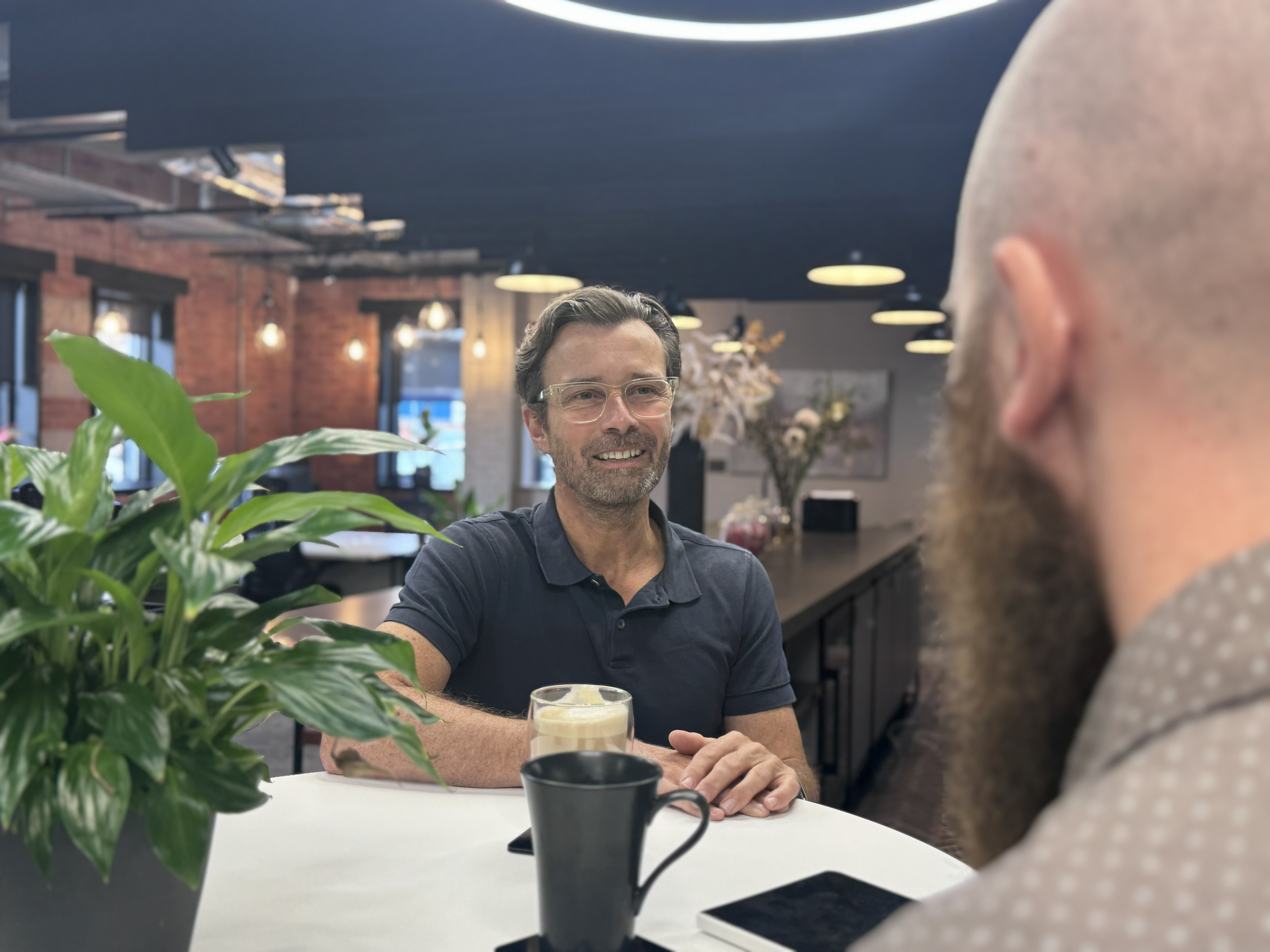
“The 1960s building brought one set of constraints, the 1980s wing another, added Egon.”
“Rooflines, windows, brickwork, levels and circulation all had to be considered before the more visible design decisions could even begin, but those constraints also created opportunities.
“Original brickwork was exposed rather than covered, elements of the roof were retained and the different parts of the building were connected through a shared palette of materials, finishes and detailing.
The aim was not to make the 1960s and 1980s disappear, nor was it to make a feature of every old element simply because it was old. It was about deciding what deserved to stay and then allowing the new design to sit comfortably around it.
“Inside, there was another challenge and neither building had been created for the way people use workplaces in 2026. Shire House needed private offices, but it also needed coworking, meeting rooms, communal areas and spaces which could bring businesses and the wider community together.
“Walls were opened up, routes through the building were reconsidered and spaces that had once felt separate began to connect. The result is a building where it can be surprisingly difficult to tell where one decade stops and the other starts.”
And perhaps that’s the point, Shire House doesn’t pretend to be a brand-new building, look closely and its earlier lives are still there in the exposed brick, roof structure and occasional architectural detail, but they now sit within something which feels unmistakably contemporary.
Reusing and adapting an existing building can be more complicated than starting again. There are surprises, compromises and things an architect would never deliberately put on a blank page, yet for Egon, those are often the things that ultimately give a building its character.
And from Madrid’s curving hotel rooms to a once-empty building in Lichfield, perhaps there is a common thread after all…sometimes the most interesting spaces come from refusing to do the obvious thing.
Previous Article
« Coffee conversations with... Lynn Potter, Core SanctuaryNext Article
Coffee conversations with… Sharon McCormick »